Why Thunder Always Waits Until 3am
Thunder is a meteorological event with no regard for your sleep schedule. It does not build gradually. It arrives at full volume, directly above your house, at the exact moment you were finally getting some rest. A thorough investigation into why
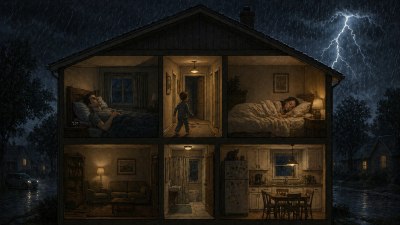
This image was created with the assistance of DALL·E
You Were Almost Asleep...
Not quite there yet, but close. The good kind of close, where the thoughts start losing their edges and the things you were worried about begin to feel further away and the pillow has reached the exact temperature it takes twenty minutes to reach and you are, genuinely, nearly gone.
Then the thunder.
Not a gentle rumble in the distance. Not the kind that rolls in slowly from somewhere far away and gives you time to register it and decide it is not your problem. The kind that starts at full volume, directly overhead, with no warning and no preamble, as if the sky has been saving it specifically for this moment. The windows rattle. The cat, if you have one, does something dramatic in the hallway. You are awake in the complete and total way that makes falling back asleep feel like a project you are not qualified to manage.
It is 3am. It is always 3am.
Why Thunderstorms Actually Do Peak at Night, Which Is the Annoying Part
The frustrating thing about nocturnal thunderstorms is that they are not imagined. They are not a psychological trick your exhausted brain plays on you, making storms feel more common at night because you notice them more when you are trying to sleep. They genuinely are more common at certain night hours, and there are real atmospheric reasons for this, and none of those reasons care at all about your sleep.
During the day, the sun heats the ground, the ground heats the air above it, and warm air rises. This convective activity is the engine of afternoon thunderstorms, which are also very common and happen to occur when most people are awake and can experience them with something approaching appreciation. Dramatic skies. The smell of rain coming. The way the light goes green before a big storm. Afternoon thunder has an audience and it performs accordingly.
At night, the dynamics change. The ground loses heat, the lower atmosphere cools and stabilises, and you might expect this to suppress storm activity. And it does, in some situations. But in others, particularly when a low pressure system or a cold front is moving through, the storm doesn't need surface heating to sustain itself. It runs on the atmospheric instability of the system itself, which operates on its own schedule, which does not align with yours.
There is also a phenomenon where storms that developed during the afternoon continue moving overnight, arriving at your specific location at whatever hour the wind delivers them. The storm did not start at 3am. It started somewhere else, hours ago, and it has been travelling. It found you at 3am. These things happen.
The Specific Architecture of 3am Thunder
Night thunder sounds different to day thunder and this is not your imagination either. There are several reasons for this and they all compound each other in the worst possible way.
First, the silence. During the day, thunder competes with traffic, with other people, with the general ambient noise of a world in operation. At 3am, the noise floor is essentially zero. The thunder does not have to compete with anything. It arrives into a silence so complete that it seems louder than it would be at any other hour, not because it is louder but because there is nothing else.
Second, temperature inversions. At night, cooler air near the ground and warmer air above it can create conditions where sound waves refract downward instead of dispersing upward. This means thunder that would normally travel up and out into the atmosphere bounces back down toward the ground, toward houses, toward the specific bedroom window you left slightly open because the evening was warm before the storm arrived. The sound is literally being redirected at you.
Third, and most importantly, you are horizontal and your eyes are closed. Every other sense is heightened when vision is removed and the body is in a resting state. The thunder hits differently when you are already somewhere between asleep and awake, when your nervous system is in its low-guard configuration, when you are not braced for anything. The startle response at 3am is a full body event in a way it simply is not at 3pm.
The thunder at 3am is the same thunder. You are a different person at 3am, and that person has no defences.
The Lightning Calculation You Do Every Time
After the first thunderclap, you will do the lightning calculation. This is the thing where you count the seconds between the flash and the thunder to determine how far away the storm is, using the rule that five seconds equals one mile. You know this rule. Everyone knows this rule. You will do it anyway, lying in bed, watching the ceiling for the next flash.
There are several problems with this calculation at 3am. The first is that you will lose count. You are tired and your counting will drift and you will either undercount, which makes the storm feel closer and more alarming, or overcount, which gives you false comfort right before the next strike is directly overhead.
The second problem is that the calculation gives you a distance but no direction. The storm is four miles away. But is it four miles away and moving toward you, or four miles away and moving past you? Is it stationary? Is it the kind of slow-moving summer storm that will sit over your house for three hours or the kind that sweeps through in forty minutes and leaves the air clean and cool behind it?
The calculation cannot answer these questions. The calculation gives you a number and then leaves you with it at 3am, which is not a good time to sit with an incomplete piece of information.
You count anyway. You have always counted. You will count next time. The counting feels like doing something, and at 3am, doing something, even something that does not help, is significantly better than doing nothing.
What the Rest of the House Does
Thunderstorms at 3am have a way of creating a household census. You discover, via the sounds that follow the first clap, exactly who in the house the thunder reached and how.
Children wake up and come to find you, which is understandable and sweet and also means that the next two hours will be spent in a bed with too many people in it and not enough duvet distributed fairly. Dogs develop opinions about the situation and share them. Cats make a noise you have not heard before and then go completely silent, which is somehow more alarming than the noise. Partners either sleep through it entirely, which is impressive and slightly unfair, or wake up briefly, say something like "just thunder" with their eyes still closed, and go back to sleep in under thirty seconds, which is a skill you have never possessed and now resent.
The house creaks in the rain. The gutters, if they need cleaning, announce this at volume. One window somewhere is open just enough to let a small amount of weather in but not enough to justify getting up to close it, so you lie there aware of it, incorporating it into the growing list of things that are happening that you cannot do anything about.
The Silence After, Which Is Its Own Problem
The storm passes. This takes however long it takes and there is no rushing it. The thunder moves off, becoming a rumble, then a suggestion, then nothing. The rain slows. The lightning stops. The house stops creaking. The cat returns from wherever it went. The particular 3am silence that follows a thunderstorm settles over everything.
And you cannot sleep.
This is the final move in the thunderstorm's approach to the night. The storm woke you up, kept you awake, and then left. But it did not leave quietly enough for your nervous system to simply switch back off. Your heart rate, elevated since the first clap, does not return to resting immediately. Your brain, which spent the last hour doing the lightning calculation and listening for the next one and cataloguing the sounds of the house, does not stop doing those things just because there is nothing left to calculate or hear.
You lie in the clean post-storm quiet and you are completely, comprehensively awake. The pillow is the wrong temperature. The duvet is in the wrong position. The child, if they came in, is sleeping diagonally across a space that used to be yours. The alarm is in three hours.
The storm is gone. It left you here. This is, in its own way, worse than the thunder.
Why You Will Not Be Prepared Next Time
You could, in theory, prepare for nocturnal thunderstorms. You could check the forecast before bed and note if storms are expected overnight. You could close all the windows. You could make sure the dog is settled and the children know what thunder is and that it is not dangerous. You could go to bed early enough that even a 3am interruption leaves you with adequate sleep on either side of it.
You will not do these things, or you will do some of them imperfectly, because preparing for a storm that might not arrive is a strange way to spend an evening, and because the forecast is, as we have discussed at length in a previous article, more confident than it has any right to be and more wrong than it admits.
The storm will come when it comes. It will be 3am or close enough to 3am that the difference is academic. It will be loud. You will be asleep, or nearly asleep, or finally asleep after a long time trying. It will find you in exactly the state it always finds you in, because that is the state you are in at 3am, and that is when the storm arrives, and that is the whole situation stated plainly.
Tomorrow you will be tired. You will tell someone about the storm and they will say they slept right through it, and you will look at them for a moment without saying anything, and then you will say: yes, it was pretty bad, and move on, because some experiences do not translate and this is one of them.
The thunder knows. It was there.