The Physics of Slush Splashing Upward
Explore the physics behind slush splashing upward, covering fluid dynamics, impact forces, and environmental factors.
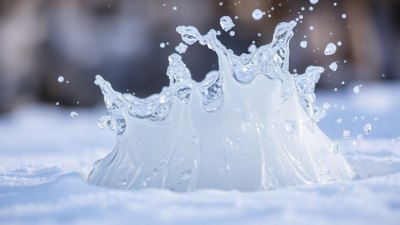
Slush, a semi-solid mixture of snow and water, often creates fascinating splash patterns when disturbed. Understanding why slush splashes upward involves a combination of fluid dynamics, impact mechanics, and material science. This article delves deeply into the physical principles governing the behavior of slush as it splashes upward, highlighting the roles of viscosity, elasticity, surface tension, and external conditions.
Defining Slush and Its Properties
Slush is not a simple liquid; it is a complex mixture exhibiting both solid-like and liquid-like properties. This heterogeneous blend consists mainly of partially melted snow crystals suspended in water. The degree of melting, temperature, and composition affect its viscosity and density. Unlike pure water or snow, slush has a yield stress, meaning it behaves like a solid until a certain stress threshold is exceeded. This property dramatically influences how it responds to impacts and why it can splash in a particular manner.
Fluid Dynamics of Mixed-Phase Materials
The fluid dynamics of slush diverge from that of Newtonian fluids due to its non-Newtonian rheology. When an object moves through slush or when slush is subjected to an impact, the flow exhibits shear-thinning behavior, where viscosity decreases with increased shear rate. This explains why slush can resist small forces but flows readily under more significant stresses, resulting in splashes when disturbed. The interaction between the solid ice particles embedded in water adds complexity, as particle collisions and rearrangements contribute to energy dissipation and momentum transfer.
Impact Mechanics and Energy Transfer
To understand the upward splash of slush, consider the impact of an object or force on the slushy surface. Upon impact, kinetic energy is transferred to the slush mixture. Because slush has mass and viscosity, energy propagates through it causing deformation and flow. The initial localized pressure wave travels through the medium and displaces slush material radially outward and upward from the point of impact. Some of the slush is propelled upwards due to the rapid transfer of momentum and interaction between the granular ice particles and liquid water phases.
Role of Viscosity and Elasticity
Viscosity determines how sluggishly or quickly a fluid flows under stress. The viscosity of slush can vary greatly depending on temperature and water content. A higher water concentration reduces viscosity, allowing a more fluid-like splash, while higher ice content increases resistance and dampens splash height. Elasticity, attributed to the partially solid phase, plays a role by temporarily storing impact energy and releasing it, contributing to the generation of upward jets or splashes. This combined viscoelastic response is essential to the characteristic upward splash of slush.
Surface Tension Effects
Although water has a distinct surface tension that affects droplet formation and splash morphology, slush’s surface tension is modified by the presence of ice crystals and impurities. Surface tension influences the cohesion of liquid particles at the interface, affecting how slush fragments and forms splashes. Reduced surface tension due to chemical impurities or temperature changes can lead to more extensive breakup and higher splashing. The interactions between surface tension and inertia determine the shape and reach of the upward splash.
Environmental Conditions Influencing Splashing
External factors such as temperature, ambient pressure, and surface roughness significantly affect slush splash behavior. Temperature impacts the phase state of the mixture—warmer conditions increase liquid content and reduce viscosity, producing more dramatic splashes. Atmospheric pressure influences the evaporation rate and bubble dynamics within slush. Surface roughness where slush lies can scatter impacting forces and alter splash patterns. Wind speed and direction may carry splashes higher or influence their trajectory.
Comparing Slush Splashing to Water and Solid Impacts
Unlike pure water splash dynamics, which can be modeled relatively simply, slush incorporates granular mechanics typical of solids and complex fluids. Water splashes upward primarily due to surface tension and liquid inertia, leading to thin jet formations and droplets. Solid impacts, however, cause localized deformation and fracturing. Slush, being intermediate, displays hybrid behavior: the fluid phase allows flow and splash while embedded solids can store and release elastic energy, creating unique upward splash characteristics not observed in homogeneous fluids or solids.
Experimental Observations and Measurements
Scientific studies on slush splashing often use high-speed video to capture impact events. Measurements focus on splash height, droplet size, and velocity distribution. Experiments reveal that impacting objects of varying shapes and speeds produce different splash profiles. For instance, a sharper impactor creates a more focused upward jet, while broader objects disperse energy laterally, reducing splash height. Temperature modulation confirms the role of viscosity and water content, with warmer slush creating higher, more dispersed splash patterns.
Mathematical Models of Slush Dynamics
Modeling slush splash phenomena requires solving the Navier-Stokes equations modified for non-Newtonian fluids with particulate phases. Computational fluid dynamics (CFD) simulations incorporate multiphase flow techniques to account for liquid and solid grains interaction. Constitutive models for viscoelastic behavior are applied to represent slush’s unique properties. These models predict velocity fields, pressure distributions, and deformation rates, which help explain the mechanism of upward splashing at multiple scales.
Application in Weather and Environmental Studies
Understanding slush splash physics has practical implications for road safety in winter conditions, where splash can affect visibility and vehicle handling. It also impacts meteorological models predicting snowfall runoff and hydrological cycle behavior in cold regions. In urban planning, controlling slush splash can minimize damage to infrastructure and pedestrians. Insights from slush dynamics support innovations in winter road maintenance technologies and materials designed to reduce hazardous splashing.
Technological Implications and Engineering Challenges
Engineering surfaces to reduce or manipulate slush splash requires leveraging knowledge about its physics. Designing hydrophobic or textured materials on roads and sidewalks can alter slush behavior and reduce upward splash. Vehicle tires and splash guards engineered with this understanding improve safety by controlling splash trajectories. Challenges arise from slush’s variability in composition and temperature, necessitating adaptive, multifunctional design solutions that respond to dynamic environmental conditions.
Future Research Directions
Further research is needed to quantify microstructural changes during impact and correlate with macroscopic splash behavior. More advanced imaging and modeling techniques can elucidate particle interactions and phase transitions in real-time. Investigations into chemical additives that modify slush surface tension or viscosity could lead to practical interventions. There is an emerging interest in bio-inspired materials and mechanisms that naturally mitigate slush splash, opening avenues for interdisciplinary exploration combining physics, materials science, and environmental engineering.
The physics of slush splashing upward integrates concepts from multiple scientific fields to explain a common yet complex phenomenon. The interplay of rheology, impact mechanics, surface effects, and environmental factors creates distinct splashes that differ significantly from pure water or solid impacts. Grasping these principles enables practical advancements in safety and environmental management during winter conditions.