How Humidity Knows Exactly When You Did Your Hair
Humidity doesn't affect everyone equally. It affects you specifically, on the days you made an effort. A thorough investigation into why moisture in the air has such a personal vendetta against good hair days
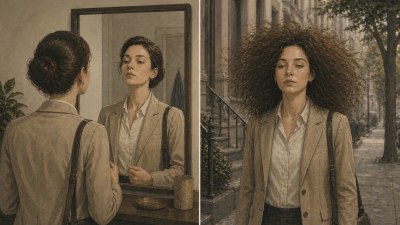
This image was created with the assistance of DALL·E
It Starts With a Decision.
On most days, you do not think too hard about your hair. You do what you do, it ends up roughly where it ends up, and you leave the house without any particular emotional investment in the outcome. These are the days humidity leaves you alone. Not completely, not always, but largely. You go about your business. Your hair goes about its business. Nobody has strong feelings.
Then there is the other kind of day.
The kind where you wash it the night before so it has time to settle. Where you actually use the good product, the one you bought on a recommendation and saved for occasions that warranted it. Where you spend real time with the dryer and the brush, working in sections, the way you have seen demonstrated in videos that make it look easy and achievable. Where you look in the mirror before leaving and think, genuinely: yes. That is what I was going for.
You step outside.
The humidity was already there. It was waiting.
What Humidity Actually Does to Hair, Technically Speaking
Hair is made of keratin, which is a protein, and keratin is hygroscopic, which means it absorbs moisture from the air around it. When humidity is high, hair absorbs water molecules and swells. The hydrogen bonds in the hair shaft, which are what hold your style in place, break and reform in response to the moisture. The shape you created with heat and product is replaced, gradually and then all at once, by whatever shape your hair decides it prefers when left to its own devices.
For straight hair, this often means volume and frizz where there was smoothness. For wavy or curly hair, it means the curl pattern changes, usually in the direction of whatever the hair feels like that day rather than anything predictable or manageable. For hair that sits somewhere in between, it means a negotiation that nobody wins.
Your hair has a preferred state. Humidity is just helping it get back there. The fact that your preferred state and your hair's preferred state are different is the central conflict of the whole situation.
Heat styling works by breaking those hydrogen bonds with temperature and then letting them reform as the hair cools in the shape you want. Products work by coating the hair shaft and slowing down the moisture absorption. Both of these interventions are real and measurable and genuinely effective under the right conditions. The right conditions do not include high humidity, which simply has more water molecules than your products have resistance, and keeps going until the balance tips.
Why It Knows When You Made an Effort
This is the part that science handles less comfortably.
The humidity level on any given morning is determined by temperature, atmospheric pressure, recent precipitation, proximity to water, and a range of other factors that have nothing to do with your morning routine. Humidity does not check your calendar. It does not know what you are doing today or how long you spent in front of the mirror. By any reasonable meteorological account, it should be equally likely to be humid on a day you tried and a day you didn't.
And yet.
The experience of high humidity landing specifically on the days that matter is so consistent, so widely reported, so immediately recognised by anyone who has ever had hair, that dismissing it as coincidence requires a level of commitment to coincidence that starts to feel like its own kind of faith.
The more plausible explanation is a psychological one, which is somehow both more satisfying and more annoying. On days when you have made no effort, you do not notice what humidity does to your hair because you had no expectations for your hair to begin with. The hair is doing its thing. That was always the plan. There is no gap between what you hoped for and what you got, so there is nothing to notice.
On days when you made an effort, you know exactly what your hair looked like when you left the house. You have a very clear mental image of the intended result. Every deviation from that image is visible to you in a way it simply isn't on ordinary days. The humidity is not worse. Your awareness of it is higher. The effort you made is now functioning as a measuring stick for everything that goes wrong.
Making an effort, in other words, is also making yourself available for disappointment in a way that not trying never is.
The Role of Important Occasions
Humidity's relationship with important occasions deserves its own section because it is particularly well documented in lived experience if not in peer reviewed literature.
Job interviews. First dates. Weddings, specifically the outdoor ones in August. School photo days, which parents of children with curly hair will tell you about with a specific expression that is somewhere between laughter and grief. The one work presentation you have been preparing for three weeks. The reunion where you wanted to look like things had gone well for you.
These events share a common feature, which is that you cared about how you looked going into them, and humidity cared about that caring, and showed up accordingly.
There is a particularly cruel variation of this that happens at weddings, where the humidity is often highest during the photographs, which are taken outside, in the middle of the day, in the warmest month anyone could find on the calendar. Wedding photographers are familiar with this. They have presets for it. There is a specific kind of editing that is sometimes called "fixing the hair" in post, which is a tactful way of describing the removal of humidity's contribution to what was supposed to be a formal portrait.
Humidity does not respect the occasion. It respects only the dew point, which it will hit on its own schedule regardless of what you have booked the venue for.
Products That Promise to Help and What Actually Happens
The anti-humidity hair product market is significant, which tells you two things. First, that a lot of people experience this problem. Second, that the problem is not fully solved, because if it were, there would not need to be so many products competing to solve it.
Anti-humidity sprays and serums work by creating a barrier between the hair shaft and the moisture in the air. They are effective in the same way that an umbrella is effective: genuinely useful up to a point, and then overwhelmed when the conditions exceed what they were designed for. A light humidity day, a product-assisted hairstyle will hold reasonably well. A genuinely humid day, the kind where the air feels like a warm damp towel, the product buys you perhaps forty minutes before the atmosphere wins.
The forty minutes, it should be noted, are rarely the forty minutes you needed. They are usually the forty minutes on the bus, or the walk from the car to the building, or the time spent waiting outside for the thing to start. The hair looks good in the cab on the way there. It has opinions by the time you arrive.
Making Peace With It, or Not
There are people who have genuinely made peace with humidity and their hair. They exist. They tend to have either fully embraced their hair's natural state, working with what humidity produces rather than against it, or they have moved somewhere dry, which is a significant life decision to make on the basis of a weather phenomenon but which nobody who has done it seems to regret.
For everyone else, the relationship with humidity is an ongoing negotiation that never quite resolves. You learn which products help. You learn which styles hold better than others. You learn to check the humidity forecast the same way you check the rain, and to adjust your expectations accordingly, and to reserve the real effort for the low-humidity days when the atmosphere is willing to cooperate.
And on the days it isn't, you remind yourself that humidity is indiscriminate, that it is doing this to everyone, that the person across the room who looks fine probably has a different hair type or a better product or simply decided not to care today, and that caring less is always available as a strategy even if it is very hard to execute when you spent forty minutes with a brush this morning and you know exactly what it looked like when you left.
The humidity knew. It always knows. And it came anyway.