Why the Sky Goes Grey on the One Day You Needed It Not To
The sky was blue for eleven days straight. You had one thing planned. You had one day that needed the sun. The sky knew, and it made other arrangements
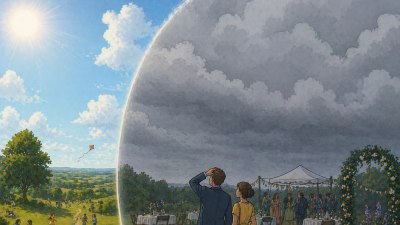
This image was created with the assistance of DALL·E
Eleven Days of Sun and Then This...
Let's start with the record, because the record is important and deserves to be stated before anything else. In the ten days leading up to today, the sky was clear. Not partly clear, not mostly clear with some cloud in the afternoon. Clear. The kind of blue that makes people take photographs of it and send them to friends with no message, just the photograph, because the photograph is the message and the message is: look at this, it has been like this for ten days, it is extraordinary.
You did not need those ten days. You had things to do. You were inside for most of them, at a desk or in a meeting or doing the things that constitute a normal week, glancing out at the blue sky with mild appreciation but no particular urgency because there would be more of it. The forecast said so. The forecast was right for once, ten days in a row, and you appreciated the sun through windows and went about your life and thought, in the loose and unexamined way people think about good things that seem to be continuing: this is good, this will keep being good.
Then you made the plan.
The specific plan, the one that required the sun, the one that had been building for weeks or months or in some cases years. The outdoor wedding. The graduation photographs. The birthday party in the garden that cannot easily be moved inside because inside is not big enough and because the whole point was the garden. The trip you saved for. The first day of the holiday. The one morning you had free in three months and chose to spend outside because outside finally seemed possible.
You made the plan and you went to sleep and you woke up and the sky was grey.
Not a threatening grey, not a stormy grey with something to say for itself. A flat, non-committal, completely featureless grey that stretched from one edge of the visible sky to the other with the unbroken consistency of something that had been there for hours and intended to stay. The blue of the previous ten days was gone as completely as if it had never happened. The sun was somewhere behind the grey, presumably, technically, but it had no effect on anything happening below it.
The grey arrived overnight. It did not announce itself. It simply replaced the blue while you were sleeping, efficiently and without drama, and presented itself as the sky for the day you needed most.
Why This Happens, Atmospherically Speaking
Extended periods of high pressure, which are what produce the long stretches of clear blue sky that make you feel like the summer has finally arrived and intends to stay, are inherently temporary. High pressure systems move. They weaken. The atmospheric conditions that maintain them shift, and when they shift, cloud cover returns, often quickly and often completely, because the transition from a stable high-pressure system to the more typical mixed conditions of a temperate climate is not gradual. It happens when it happens, and when it happens it covers the sky in a day.
The reason it happens on the specific day you had plans is not meteorological. Meteorologically, the system did not know about your plans. The isobar charts were not consulted about the wedding. The high pressure system was going to move when the conditions caused it to move, and the conditions caused it to move on this particular day, and this particular day happened to be the one you needed.
This is the honest answer and it is deeply unsatisfying, which is why people do not find it comforting when it is offered to them on the morning of the thing they planned around the sun.
The more satisfying answer, the one that matches the emotional reality of the experience without being literally true, is that the sky was paying attention. That it tracked the ten days of plans-not-made and identified the one day where blue sky was genuinely necessary and made its move then, specifically then, in the way that feels too pointed to be coincidence even when it is exactly coincidence and nothing else.
The Specific Quality of Grey on Important Days
Grey sky is not a single thing. There are many kinds of grey sky and they are not equivalent, and the one that arrives on important days is a specific kind that deserves its own category.
There is dramatic grey, which has structure and movement and weather happening in it, dark clouds with intention, the kind of sky that at least commits to something. There is silver grey, which in certain lights is almost beautiful, which photographers call overcast and use deliberately because it produces even, flattering light. There is pale grey that might clear by mid-morning, that carries within it the possibility of improvement, that gives you something to watch and hope toward.
The grey that arrives on the day you needed the sun is none of these. It is a medium, textureless, motivationally bankrupt grey that offers nothing. It is not going to storm. It is not going to clear. It is not interesting from any angle. It is just grey, solid and even and completely committed to being exactly this and nothing more, for the entire duration of the day, from the moment you woke up to the moment the event was over, at which point it may or may not lighten slightly, too late to matter, as if making a small conciliatory gesture after the damage is done.
This specific grey is the sky's least dramatic and most effective move. A storm would at least be something. A storm has energy and has the decency to be memorable. This grey is just absence. The absence of the thing you needed, sustained quietly and completely for exactly as long as it needed to be.
The Photographs Problem
Grey sky photographs differently from blue sky in ways that matter a great deal on days when photographs are being taken, which is to say: outdoor weddings, graduations, birthday parties, the holiday you saved for, any event where the visual record of the day is part of the day itself.
Blue sky in photographs is unambiguously good. It is warm and saturated and it makes everything below it look better than it would otherwise. People look healthier in photographs taken in actual sunlight. Colours are more themselves. The whole image has a quality that says: this was a good day and the day knew it.
Grey sky in photographs is, at best, neutral. The light is flat. The colours are muted. The background behind the subjects, which was supposed to be blue and clear and summery, is a pale nothing that could be any day in any season and conveys no information about the warmth or the occasion or the fact that it was supposed to be beautiful. The photographer will say the overcast light is actually quite good for portraits, which is true, and which you will appreciate in theory while looking at the photographs later and thinking: you can tell it was grey.
You can always tell it was grey. The photographs from grey days have a quality that is distinct and immediately recognisable, and ten years from now you will look at the photographs from this day and know, in the first second, that the sky was not what you wanted it to be.
What You Do With the Grey, Practically
You proceed. This is the main thing and it is the right thing and it is also harder than it sounds because the grey sits over the day like a low ceiling and the low ceiling changes the feel of everything below it in ways that are hard to counter with attitude alone.
You tell people it might clear later, which it might, and which gives everyone something to check the sky for during the event, a small shared project of optimism that costs nothing and occasionally pays off. You adjust the plan where the plan can be adjusted, move things earlier or later or slightly differently to work with the light available rather than the light you ordered. You make the best of it, which is a phrase that carries within it the full weight of human disappointment managed gracefully, which is the best available outcome on a grey day and is genuinely underrated as an outcome.
And you notice, because you always notice, that the people who arrived without expectations are having a perfectly good time. The grey sky is not bothering them the way it is bothering you, because they did not build the day around the blue. They built the day around the event, and the event is happening, and the sky is whatever the sky is, and they are eating the food and talking to the people and doing the thing, and the grey is just weather to them, which is all it ever was, which is all it ever is, even when it does not feel like that.
The Next Day, Which You Already Know About
The sun comes back the next day. This is so consistent that it barely needs saying, but it needs saying because the consistency is the thing, because it happens every time with a reliability that the forecast cannot match but that lived experience can confirm without hesitation.
The next day is blue. Sometimes the day after the event is the most beautiful day in weeks, a clear brilliant blue that arrives like a joke being completed, that makes the garden or the venue or the park look exactly as you imagined it would look and did not. The light is good. The temperature is right. Everything that was supposed to happen yesterday would have been perfect today.
Today you have nothing planned. The event is over. The photographs are taken, grey-skied and already being edited. The guests have gone home. The occasion has passed into the past where occasions go, and the sun has come out to illuminate the space it left behind.
You stand in it for a while. It is warm. It is genuinely, properly warm, and the sky is the blue it was for ten days before yesterday, and you feel it on your face and you think: of course.
Of course it is beautiful today.
The sky was always going to do this. It always does this. You know it always does this, and you will plan something again anyway, and the sky will make its own arrangements, and you will stand in the sun the day after and think: of course, again, because of course is the only thought available and it contains, if you let it, something almost like affection for the whole absurd reliable pattern of it.
The sky is not against you. It just has very bad timing and absolutely no awareness of your calendar.
Neither does it apologise. You have noticed this.