The Physics of Puddles That Are Deeper Than They Look
A puddle looks like nothing. An inch, maybe two. You make a calculated decision and step in. It is eight inches deep and your sock is completely wet and the day is changed. A full investigation into why puddles lie and what that says about trust
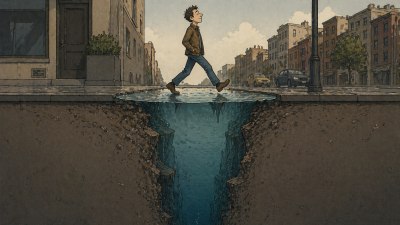
This image was created with the assistance of DALL·E
Let's establish this first, because it matters. You did not step into that puddle carelessly. You looked at it. You made an assessment. You considered the surface area, the colour of the water, the way it reflected the sky, and you arrived at a conclusion that any reasonable person would have arrived at: shallow. Passable. Fine.
You were not being reckless. You were using the available information. The available information was wrong, but that is not the same thing as you being wrong, and this distinction is important to hold onto because the next several hours of walking around with a wet sock are going to make you feel like you should have known better. You should not have known better. The puddle was lying.
This is what puddles do. It is, in a sense, the only thing puddles do, because a puddle that is exactly as deep as it looks is not a puddle you remember. It is just water on the ground. The puddles that make an impression, the ones that change the character of a morning, are the ones that present as shallow and deliver something else entirely. They are the ones with a story.
Why Water Looks Shallower Than It Is
The physics of this are real and have a name, which is refraction. When light travels from air into water it slows down and bends, and this bending changes the apparent position of anything beneath the surface. Objects at the bottom of water appear closer to the surface than they actually are, because your eye traces the bent light rays back in a straight line and arrives at the wrong depth.
This effect is consistent and measurable. Water with a refractive index of approximately 1.33 makes the bottom appear about 75% of its actual depth. A puddle that is eight centimetres deep looks like it is six centimetres deep. A puddle that is twenty centimetres deep, the kind that lives in a pothole on a road that has not been repaired since the previous government, looks like fifteen. The physics are always working against you, always in the same direction, always making the water look shallower than it is.
There is no optical illusion that makes puddles look deeper than they are. The deception runs one way only, and it runs consistently toward making you think you can step in it.
Turbidity makes this worse. Clear water at least lets you see the bottom, which you will underestimate due to refraction but which gives you some information. Murky water, the brownish kind that forms on streets after rain mixes with whatever a city street is made of at the molecular level, gives you nothing. The bottom is invisible. You are estimating based on the surface, which is a circle of brown water that could be two centimetres deep or could contain a pothole of genuinely impressive ambition. You have no way to know without stepping in it, which is the only measurement tool available, and which is also the thing you were trying to avoid doing.
The Pothole Problem, Which Is a Separate But Related Issue
A puddle on flat ground is one thing. A puddle that has formed over a pothole is something else, and deserves its own section because it represents a particular category of betrayal.
Potholes form because road surfaces crack, water gets in, freezes, expands, and breaks the surface apart. This process happens most energetically in wet, cold weather, which is also the weather that produces puddles. So the conditions that create potholes are the same conditions that then fill them with water and hide them completely. The pothole and the puddle are not separate problems that happen to coexist. They are the same problem, one producing the other, and then the other covering the first so thoroughly that you cannot tell they are related until your foot is in both of them simultaneously.
The depth of a pothole puddle is essentially unknowable from the surface. Potholes vary from a couple of centimetres to depths that have been photographed and put on local news websites with headlines about infrastructure. Most are somewhere in the middle, which is still enough to clear the top of a regular shoe and make contact with the sock in a way that cannot be undone without going home and changing.
The puddle is not the problem. The puddle is the announcement that there is a problem, delivered just slightly too late to be useful.
Surface Tension and Why the Puddle Looks Solid
Water has surface tension, which is a property created by the cohesive forces between water molecules at the surface pulling inward and creating a kind of skin on top of the water. This skin is real and measurable and is why some insects can walk on water without sinking. It is also why a puddle surface can look, from certain angles and in certain lights, almost solid. Reflective. Stable. Like something you could step on rather than in.
The surface tension of water is not strong enough to support a human being. Not even slightly. A water strider weighs a fraction of a gram and distributes its weight across specialised legs designed for exactly this purpose. You weigh considerably more and are wearing shoes that were not engineered with surface tension in mind. The moment your foot makes contact, the surface breaks, your shoe goes through, and the depth of the puddle reveals itself all at once.
There is no way to step gently enough. There is no technique. People have tried stepping quickly, stepping on the edge, stepping with the side of the foot. The puddle does not respond to technique. It responds to physics, and the physics are not on your side.
The Specific Misery of the Wet Sock
A wet sock is not a neutral event. It is a condition that alters the entire remaining trajectory of a day in ways that are difficult to explain to someone who is not currently experiencing one.
The wetness itself is cold and immediate, arriving all at once in the moment of the step. This is followed by a brief period of hope, the hope that it is not as wet as it felt, that maybe just the edge got it, that by some miracle the shoe was waterproof enough to limit the damage. This hope is always misplaced. The sock assessment, conducted discreetly while walking, reveals the full situation within about thirty seconds.
After that comes the walking. Every step reminds you. The sock moves slightly inside the shoe in a way it does not move when dry. It makes a sound that is too quiet for anyone else to hear and too present for you to ignore. The cold becomes less cold as your foot warms the water, which sounds like an improvement but is actually worse because warm wet is more intimate than cold wet and harder to ignore.
You think about the wet sock approximately every forty-five seconds for the rest of the morning. You think about it in meetings. You think about it while eating lunch. It becomes a minor but persistent background condition, like a low-grade headache that never quite arrives and never quite leaves.
The sock dries eventually, usually by early afternoon, and leaves a faint watermark around your shoe that serves as a record of the event for anyone who knows what they are looking at. Which is nobody. But you know. And you look at it on the bus home and you remember the puddle and you think: it looked so shallow.
Why You Will Step in Another One
This is perhaps the most interesting aspect of the puddle situation, which is that it will happen again. You know it will happen again. Everyone who has stepped in a deep puddle knows it will happen again. The knowledge gained from one puddle does not transfer cleanly to the next one because puddles are individually unique and each one requires its own assessment, and the assessment tools available are the same ones that failed last time.
You will look at the next puddle and you will think: that one looks shallow. You will think this because it does look shallow, because puddles always look shallower than they are, because the physics have not changed and will not change regardless of how many times you have been surprised by them.
The only reliable puddle avoidance strategy is to avoid all puddles regardless of apparent depth, which requires treating every puddle as a potential pothole disaster and routing around all of them, which adds time and distance to every wet-weather journey and also sometimes routes you through a different puddle you did not see because you were busy avoiding the first one.
The alternative is to accept that occasionally you will step in a deep puddle, that your sock will be wet, that the day will be slightly worse for a few hours, and that this is a known and recurring feature of moving through the world on foot in a climate that produces rain. It is not a character flaw. It is not a failure of judgment. It is refraction and potholes and the basic geometry of water on an uneven surface.
The puddle was always going to be deeper than it looked. That is, at this point, the most reliable thing about it.