How Ice Crystals in the Atmosphere Create Optical Illusions Like Halos
Explore how atmospheric ice crystals produce stunning optical illusions such as halos through light refraction and reflection.
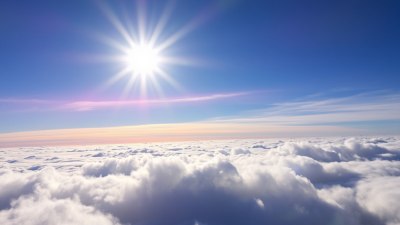
Image created with Flux Schnell
Nature often surprises us with breathtaking displays of light and color in the sky. Among the most dazzling atmospheric phenomena are optical illusions created by ice crystals. These illusions, including halos, sun dogs, and light pillars, captivate observers across the globe. Understanding how ice crystals in the atmosphere generate these spectacular effects reveals a fascinating interplay between physics and meteorology.
At the heart of these optical illusions are tiny ice crystals suspended in the Earth's atmosphere. Typically found in cirrostratus clouds high above the surface, these ice crystals have geometric shapes—primarily hexagonal plates and columns. The way they interact with sunlight or moonlight leads to refraction, reflection, and dispersion of light, producing vivid and sometimes mysterious visual effects.
The Nature of Atmospheric Ice Crystals
Ice crystals form in the upper troposphere where temperatures are well below freezing, often below -40 degrees Celsius. Here, water vapor deposits directly onto small particles or existing ice, forming ice crystals without passing through a liquid phase. The most common shapes under these conditions are hexagonal prisms that grow either as flat plates or elongated columns based on temperature and humidity levels.
These crystals vary in size from a few micrometers to several millimeters. Their hexagonal symmetry is crucial because it causes light to bend and reflect in predictable ways, setting the stage for optical phenomena like halos and sun dogs.
Basic Physics of Light Interaction with Ice Crystals
When light encounters an ice crystal, several things can happen: it can be refracted (bent), reflected, or dispersed (split into colors). The specific behavior depends on the crystal's shape and orientation and the light's wavelength and angle of incidence.
Refraction occurs when light passes from one medium into another—in this case, from air into ice. Since ice has a higher refractive index than air, light bends toward the normal upon entry and away upon exiting. This bending causes light rays to deviate from their original paths, creating arcs and rings around the sun or moon.
Reflection happens on the surfaces of ice crystals, either internally or externally. Multiple internal reflections within hexagonal columns and plates can lead to intensified and shifted light paths, contributing to the brightness and sharpness of halos.
Dispersion is responsible for splitting white light into a spectrum of colors, often seen at the edges of halos where light refraction varies slightly across wavelengths, similar to a rainbow.
Formation of 22-Degree Halos
One of the most common and recognized atmospheric optical illusions is the 22-degree halo, a bright ring around the sun or moon with a radius of approximately 22 degrees. It is formed predominantly by randomly oriented hexagonal ice crystals acting as prisms that bend light by exactly 22 degrees.
To understand this, envision sunlight entering one hexagonal face of a crystal and exiting through an adjacent face. Due to the 60-degree angle between these faces and the refractive properties of ice, the light always bends at minimum by 22 degrees. This consistent deviation angle creates the circular halo around the light source.
The randomness of crystal orientation ensures the halo is seen as a ring rather than a discrete point or line. Moreover, some halos exhibit a subtle reddish tint on the inner edge and bluish or white on the outer edge, owing to dispersion effects.
Sun Dogs and Their Distinctive Appearance
Sun dogs, or parhelia, appear as bright patches of light located roughly 22 degrees to the left and right of the sun, often on the same horizontal line. Unlike the circular 22-degree halo, sun dogs are more localized and can show distinct colors, resembling miniature rainbows.
They arise from sunlight refracting through plate-shaped ice crystals that are horizontally oriented. This uniform alignment causes light to be focused at specific points, intensifying brightness and enabling vivid coloration. Sun dogs are often more prominent when the sun is low on the horizon, especially during cold mornings.
The physics behind sun dog formation underlines the importance of ice crystal shape and orientation. While halos rely on randomly oriented crystals, sun dogs require crystals aligned horizontally due to aerodynamic forces as they fall.
Other Halo Phenomena and Their Causes
Besides 22-degree halos and sun dogs, there are other more complex phenomena such as 46-degree halos, circumzenithal arcs, and light pillars:
- 46-Degree Halos: These larger halos form when light refracts through different crystal faces at wider angles but are rarer and often fainter compared to 22-degree halos.
- Circumzenithal Arcs: Known as the 'upside-down rainbow,' these colorful arcs appear near the zenith. They form when sunlight refracts through horizontally oriented, flat hexagonal crystals, specifically through their top and bottom faces, bending light at a steep angle.
- Light Pillars: Vertical columns of light extending above or below a light source, arising from reflection off flat, horizontally floating ice crystals. They do not involve refraction but are an intriguing part of the family of ice crystal optical displays.
Modeling Ice Crystal Optics
Over decades, scientists have developed models and used ray tracing techniques to simulate how ice crystals interact with light. By measuring the precise angles and indices of refraction for ice, alongside crystal morphology distribution in clouds, models predict intensity, color, and shape of halos and related phenomena with high accuracy.
This modeling blends atmospheric physics, crystallography, and optics, enabling both better scientific understanding and practical weather forecasting. Observations of halos can indicate the presence of thin cirrostratus clouds, which often precede weather changes such as an approaching front.
Historical and Cultural Significance
Historical records reveal that halos and sun dogs have fascinated humanity for millennia. Ancient civilizations often interpreted these light effects as omens or messages from the divine. For instance, Norse mythology references 'sun dogs' as manifestations of the god Odin's influence.
In more recent times, halo observations have contributed to scientific progress in atmospheric studies. Early meteorologists used halo displays as indicators of atmospheric moisture and temperature profiles at high altitudes.
Practical Observations and Photography Tips
To observe ice crystal optical illusions, one should look toward the sun or moon when thin cirrostratus clouds are present. These clouds provide a suitable concentration of ice crystals without obscuring the light source. Early morning or late afternoon often provides the best viewing opportunities because of the sun’s lower elevation.
Photographers aiming to capture halos and sun dogs use wide-angle lenses to encompass the full circle or the bright sun dogs on either side. Since these phenomena occur around bright light sources, using appropriate filters such as neutral density can help avoid overexposure while preserving color and detail.
The Impact of Climate and Pollution on Ice Crystal Optics
Climate change and atmospheric pollution can influence the prevalence and appearance of ice crystal optical illusions. Changes in temperature and humidity affect the formation of cirrus and cirrostratus clouds, impacting the concentration and types of ice crystals available.
Pollutants can act as nuclei for ice crystal formation but may also alter crystal shapes or cause irregularities that disrupt typical halo formation. Monitoring these variations aids in understanding broader environmental changes and their effects on atmospheric phenomena.
Ice crystals suspended high in the atmosphere act as natural prisms, mirrors, and lenses. Through complex interactions of refraction, reflection, and dispersion, they generate beautiful optical illusions that have inspired human wonder and scientific inquiry alike. Halos, sun dogs, light pillars, and similar phenomena serve as a vivid reminder of how natural physical principles manifest visibly in our everyday sky.
By studying these effects, scientists deepen their understanding of atmospheric conditions and provide valuable insights into meteorology, optics, and climate science. For casual observers, a simple glance skyward can reward with remarkable and ephemeral glimpses of nature’s artistry, created by the delicate ice crystal canvases high above.