Why Weather Always Matches Your Mood, But Worse
Why the weather always seems to reflect your mood—but slightly worse—and how perception, attention, and timing turn ordinary skies into emotional overstatements
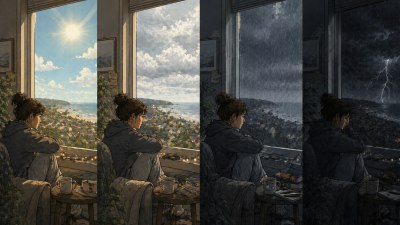
This image was created with the assistance of DALL·E
The weather does not know how you feel.
It does not track your mood, respond to your thoughts, or adjust itself to match your internal state. It operates independently, following patterns of pressure, temperature, and moisture that have no awareness of your current situation.
And yet, it is consistently, convincingly aligned with your mood.
Not exactly. Slightly worse.
The Agreement Is Always Too Accurate
On days when you feel low, the sky tends to be grey.
Not dramatically stormy. Not interestingly chaotic. Just flat, uniform, and persistent in a way that removes contrast from the world. Light becomes diffused. Edges soften. Colors lose confidence. The environment reflects your mood, but without variation or interruption.
It does not comfort you.
It confirms you.
This is the first problem. The weather does not contradict your mood. It reinforces it with slightly more commitment than necessary.
Why It’s Never Just Neutral
Neutral weather is difficult to notice.
A mild, balanced day with no strong features rarely registers as meaningful. It does not interrupt your thoughts or demand interpretation. It simply exists in the background.
But when your mood is already defined—tired, restless, distracted, overwhelmed—the background becomes visible.
The sky is not just present. It becomes part of the context you are evaluating. And once you start evaluating it, neutrality disappears.
The light is slightly too dim. The air is slightly too still. The temperature is slightly off from what would feel comfortable. None of these are extreme, but together they create the impression that the weather is participating in your mood, rather than ignoring it.
It is not neutral anymore.
It is slightly unhelpful.
The Amplification Effect
Weather rarely mirrors your mood exactly.
It amplifies it.
If you feel calm, the day is unusually still. If you feel unsettled, the wind is inconsistent. If you feel distracted, the sky is full of shifting clouds that suggest change without delivering clarity. If you feel optimistic, the sun is almost too bright, bordering on excessive, making the day feel more demanding than encouraging.
The weather takes your internal state and extends it outward, increasing its scale and removing your ability to ignore it.
What was manageable inside becomes ambient outside.
Why Bad Moods Get the Worst Skies
There is a particular quality to overcast weather that makes it uniquely effective at supporting a bad mood.
It is continuous.
Rain can stop. Wind can shift. Even storms move through and resolve themselves. But a solid layer of cloud can remain in place for hours, sometimes days, without change. It creates a ceiling that feels fixed, limiting the sense of space above you.
This lack of variation aligns closely with how a bad mood behaves.
It is not dramatic enough to be interesting. It is not temporary enough to ignore. It is simply there, consistent and difficult to move beyond.
The sky does not cause the mood, but it provides an environment in which the mood feels more stable than it actually is.
Why Good Moods Get Overcomplicated Weather
When you feel good, the weather often becomes slightly too active.
The sun is strong, but interrupted by clouds that pass just often enough to be noticeable. The air is warm, but occasionally too warm. The wind is present, but not consistently helpful. The day is good, but not settled.
This creates a subtle instability.
You are in a positive state, but the environment refuses to remain aligned with it. It introduces variation where you would prefer consistency. It reminds you that conditions are temporary, even when they feel ideal.
The result is not a bad day.
It is a good day that requires more attention than expected.
The Timing Problem
Weather and mood rarely begin at the same time.
One leads. The other follows.
You wake up feeling a certain way, and then you notice the sky. Or you notice the sky, and then your mood adjusts slightly in response. Either way, the alignment feels immediate, even though it is the result of sequence, not coordination.
Because of this, the weather often feels like a continuation of your mood rather than a separate condition.
And once that connection is established, every detail reinforces it.
A break in the clouds is not just a change in light. It is a shift in tone. A sudden gust is not just air movement. It is interruption. A brief moment of sun is not just brightness. It is contrast against everything else that remains unchanged.
The weather becomes expressive, even though it is not trying to express anything.
Selective Attention Does the Rest
You do not observe all aspects of the weather equally.
You notice the parts that match what you already feel.
If you are tired, you notice how still everything is. If you are restless, you notice every small movement. If you are frustrated, you notice inconsistency. If you are calm, you notice balance. The same set of conditions can be interpreted in multiple ways, but your attention selects one interpretation and builds on it.
This creates the illusion that the weather is adapting to you.
In reality, you are editing the weather down to the version that feels most relevant.
Why It Always Feels Slightly Worse
If the weather matched your mood exactly, it would disappear into it.
You would not notice the alignment because it would feel natural, expected, and complete. The environment would neither support nor challenge your internal state. It would simply exist alongside it.
But the weather is rarely exact.
It is slightly off.
This slight difference is what makes it noticeable. The sky is a little darker than your mood. The wind is a little more disruptive. The sun is a little brighter. The stillness is a little more complete. These small deviations create tension.
The weather does not just reflect your mood.
It overstates it.
The Atmosphere Is Not Responding
It is important, though not particularly helpful, to understand that none of this is intentional.
The atmosphere does not observe you. It does not interpret human emotion. It does not adjust cloud cover, wind speed, or sunlight based on your internal state. It operates on physical processes that are consistent, measurable, and entirely indifferent to your experience.
The alignment between mood and weather is a product of perception, timing, and attention.
But understanding this does not remove the effect.
It only explains it.
What You Can Do About It
You can change your environment, slightly.
Light, movement, and exposure to different conditions can shift how you experience both the weather and your mood. Stepping outside, even briefly, can alter the balance between observation and participation.
You can notice the full range of conditions, not just the parts that align with how you feel. This does not change the weather, but it broadens your interpretation of it.
Or you can accept the exaggeration.
The sky will continue to appear as though it understands you.
It will continue to reflect your mood with a degree of emphasis that feels unnecessary.
It will continue to be slightly worse than you are.
Not because it knows anything about you,
but because you are very good at finding yourself in it.