The Meteorology of BBQ Smoke Always Finding Your Face
You moved. You moved again. You are now standing somewhere geometrically impossible to reach and the smoke found you in four seconds. A full investigation into why BBQ smoke is personal
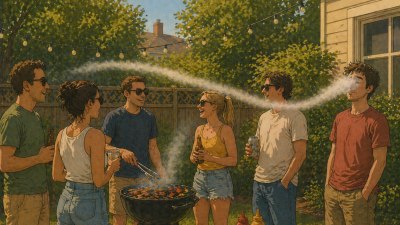
This image was created with the assistance of DALL·E
You Are Not Imagining It...
Before anything else, this needs to be said clearly and without qualification: the smoke is following you. Not in a metaphorical sense, not as a figure of speech, not as the kind of exaggeration people use when they mean "this happens to me more than seems fair." In a real, documentable, physically explicable sense, the smoke is doing something that produces the consistent outcome of ending up where your face is, regardless of where your face goes.
You have moved. Multiple times. You started on one side of the barbecue because that seemed like the right place to stand, and the smoke came that way, and you moved to the other side, and the smoke came that way too, and you moved to a position that required you to stand slightly behind a hedge and hold your drink at an angle and the smoke found you there within seconds, unhurried, certain, as if it had never considered going anywhere else.
Other people are standing around the same barbecue. The smoke is not going to them with the same dedication it goes to you. This is the part that is hardest to accept and easiest to observe. Someone else is standing downwind, or near the smoke's apparent direction of travel, and they are fine. They are having a conversation and holding their burger and not doing anything to avoid the smoke because the smoke is not interested in them the way it is interested in you. You are doing everything to avoid it and it is finding you anyway.
This is not personal. But it is also completely personal. Both of these things are true and the physics explain the first one without doing anything at all about the second.
What Smoke Actually Does in Air, Which Is Not What You Think
Smoke does not travel in a straight line downwind the way it appears to from a distance. Up close, at barbecue scale, smoke behaves as a buoyant plume in a thermally complex environment, which is a technical way of saying it goes in multiple directions simultaneously and is subject to influences that have nothing to do with the main wind direction.
The barbecue itself produces heat, which creates an updraft directly above the coals. This updraft carries smoke upward until it encounters the ambient air flow, at which point it bends and travels downwind. But the downdraft on the leeward side of the barbecue, the side you moved to in order to escape the smoke, creates a recirculation zone where air and smoke curl back toward the source before dispersing. This recirculation zone is exactly where people stand when they move away from the smoke. It is also exactly where the smoke ends up going.
In practical terms: the side of the barbecue that looks like it is away from the smoke is the side where the smoke recirculates. You moved to the recirculation zone. You did this because it looked like the safe side. It is not the safe side. There is no safe side at barbecue scale. There is only the main plume direction and the recirculation zone, and between them they cover all available standing positions within a normal social radius of the fire.
The people who are not getting smoked are standing further away than is socially comfortable, or they are upwind by accident rather than design, or they are simply in a position that the recirculation pattern has not reached yet, which will change in approximately four minutes when someone opens a gate or a door and the air flow shifts.
The Moving Problem and Why It Makes Things Worse
The instinct when smoke finds your face is to move, and the instinct is correct in the sense that staying in a smoke plume is worse than leaving it, but the instinct is wrong in the sense that moving disrupts the air around you in ways that draw the smoke toward the new position.
When you move, you displace air. The displacement creates a small area of lower pressure behind you, which the smoke, as a buoyant particle-laden gas seeking to fill pressure differentials, moves into. You have essentially created a brief vacuum in the shape of a person and the smoke has filled it. You arrive at your new position and turn around and the smoke is already there, not because it followed you exactly but because the fluid dynamics of your movement through the air created conditions that brought it to where you are going rather than where you were.
Standing still, counterintuitively, is sometimes the better strategy. A stationary person does not create pressure differentials. The smoke may still find you via the recirculation zone, but it does so at the pace of the ambient airflow rather than at the pace of a person walking briskly through a garden trying to escape it.
Nobody stands still at a barbecue when the smoke comes, because standing still in smoke feels like giving up, and the social context of a barbecue does not support giving up. You move. The smoke follows. You move again. This continues until the wind shifts or the coals die down or you go inside on the pretext of getting something and stay inside slightly longer than necessary, breathing clean air, composing yourself.
The Person Running the Barbecue, Who Is Never Affected
This requires acknowledgment because it is one of the more consistent features of the barbecue smoke situation and one of the least explicable from a pure fluid dynamics standpoint.
The person standing directly over the barbecue, tending the food, closest to the source of the smoke by a significant margin, is almost never the person who gets the worst of it. They get some smoke. They are not unaffected. But they are not the person standing twelve feet away with streaming eyes and smoke in their hair and the smell of charcoal embedded in a shirt that was clean this morning.
Part of this is because the person running the barbecue is directly in the main updraft, which carries the smoke upward above them rather than into them horizontally. Part of it is because they are moving constantly, turning things, adjusting things, never stationary long enough for the recirculation pattern to catch up with them. Part of it is because they are facing downward toward the grill, which puts their face below the main smoke level, while everyone else is upright with their faces in exactly the zone the smoke is travelling through.
The lesson here, which is genuinely useful and which almost nobody applies, is that standing over the barbecue is safer than standing around it. The person in charge of the food is in the least dangerous position. Everyone watching them from a polite social distance is getting smoked continuously. The barbecue has inverted the usual risk profile and nobody talks about this.
Wind Shifts and Why They Always Go the Wrong Way
Wind at ground level in a garden or outdoor space is not the steady, directional flow that weather forecasts describe. It is a constantly shifting, turbulent, obstacle-influenced movement of air that changes direction multiple times per minute in response to walls, fences, trees, buildings, the opening of doors, the movement of people, and the thermal effects of the barbecue itself.
When you move to escape the smoke, you are moving based on the wind's current direction, which is not its permanent direction. The wind shifts. It shifts toward you approximately as often as it shifts away from you, because that is what random variation does, but the shifts toward you are the ones you remember because they are the ones that bring the smoke. The shifts away from you are the ones you experience as brief respite before the next shift arrives.
The wind shift you have been waiting for, the one that would send the smoke permanently in a different direction and allow you to stand somewhere and have a conversation without your eyes watering, does not arrive on a schedule. It arrives when it arrives, which is sometimes never, and sometimes after the food is done and everyone has gone inside, and sometimes three minutes after you gave up and moved the whole conversation to the other side of the garden, at which point the wind shifts back and the smoke follows.
The Eyes, Specifically
Smoke irritates eyes through a combination of particulate matter and volatile organic compounds that interact with the tear film and the conjunctiva and produce an inflammatory response that the body correctly identifies as a problem and responds to with watering, redness, and the specific kind of discomfort that makes it impossible to have a normal face.
At a barbecue, having a normal face is important. You are at a social event. People are talking to you. You are trying to respond in a way that suggests you are engaged and comfortable and enjoying yourself, and your eyes are streaming and red and you are blinking more than is normal and the person you are talking to is being very polite about not mentioning it but is definitely noticing it.
The watering does not help. The instinct is that watering eyes are flushing the irritant out, which is true, but the flushing takes time and during the flushing you look like you are either having a strong emotional response to a conversation about where to go on holiday or suffering from an aggressive allergy, and neither of these is the impression you were going for when you arrived.
You blink. You turn away slightly. You say it's just the smoke in a tone designed to clarify that you are not crying about the holiday conversation. The smoke, having made its point, drifts briefly elsewhere before returning.
What You Can Actually Do, Practically Speaking
Stand upwind and stay there, which requires identifying the upwind position before the barbecue is lit and defending it socially for the duration of the event. This works until the wind shifts, which it will, but it buys you more smoke-free time than any other strategy.
Accept the smoke as the cost of the barbecue, which is a genuine trade-off and one that most people make implicitly anyway, since the alternative is not attending barbecues, which is a proportionate response to a problem about smoke in your eyes but not a popular one.
Volunteer to run the barbecue, which puts you in the updraft and gives you something to do with your hands and a legitimate reason to be stationary in the least smoked position available. This strategy has the additional benefit of making you the person who controls when the food is ready, which is not related to smoke but is a meaningful form of power at a barbecue and should not be underestimated.
Or move again. You will move again. The smoke will find you in the new position. This will happen several more times before the coals die down, and each time it will feel slightly more targeted than the last, because it is not targeted but it is consistent, and consistency at barbecue scale is indistinguishable from intent.
The smoke is not following you.
But it knows where you are.